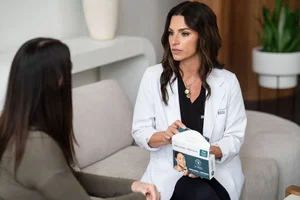
You booked your Botox appointment like clockwork. Three months, like always. But lately, you're noticing the results fading faster than they used to — more lines returning sooner, less staying power.
You're not imagining it.
If you're in perimenopause — typically your early 40s through mid-50s — there's a real, hormonal reason your injectable results are shifting. And it's something most injectors still aren't asking about.
In this article, I'll explain exactly what perimenopause does to your skin, why it changes how Botox behaves, what a perimenopause-aware injector should be doing differently — and what that means for your treatment plan.
The Hormone-Skin Connection Nobody Briefed You On
What estrogen actually does for your skin
Estrogen isn't just a reproductive hormone. It's one of the most powerful regulators of skin health in the female body. It stimulates collagen production, maintains skin thickness, supports hydration, and regulates the metabolism of the cells in your dermis — the deeper skin layer where injectable products live.
When estrogen levels are stable, your skin is relatively predictable: it holds volume, retains moisture, and responds to treatments the way it always has.
When estrogen starts declining — which typically begins in your early 40s during perimenopause — that predictability goes with it.
What perimenopause actually does to your skin
Perimenopause is the transitional phase leading up to menopause, typically spanning 4–10 years. Most people focus on the hot flashes and sleep disruption. But from a skin standpoint, this period brings a cascade of changes:
Collagen production drops by roughly 30% in the first five years of menopause — causing skin to thin and lose structural support
Skin hydration decreases as estrogen-regulated ceramide production slows
Facial fat redistribution changes the architecture your injector has always worked with
Increased cortisol (a common companion to sleep disruption and hormonal flux) speeds cellular breakdown
Faster skin cell turnover means products metabolize more quickly throughout the whole body — including neurotoxins like Botox
"Perimenopause is the transitional period leading up to menopause — and your skin responds differently to treatments during this phase. Most practitioners still aren't asking about it." — Dr. Mayoni Gooneratne, integrative aesthetics specialist, Marie Claire UK, May 2026
Why Your Botox May Be Wearing Off Faster in Perimenopause
This is the question I hear most often from clients in their 40s and early 50s who've been getting Botox for years. The short answer: your body is metabolizing the neurotoxin faster. Here's why.
1. Accelerated metabolism of neurotoxins
Botox (botulinum toxin) works by temporarily blocking nerve signals to facial muscles. Your body eventually breaks it down — that's why results last 3–4 months for most people.
During perimenopause, the metabolic changes that accompany hormonal fluctuation can accelerate how quickly your body processes everything — including neurotoxins. It's not that Botox has stopped working. It's that your system is processing it faster than it used to.
2. Collagen loss changes how product behaves in the tissue
With thinner dermis and reduced collagen scaffolding, injectable products have less tissue structure to anchor to. This affects not just longevity but spread — the product can diffuse differently than it did when your skin was denser.
An experienced injector needs to know this going in. Dosing that worked at 38 may need to be reconsidered at 48.
3. The injection timing shift most providers are missing
Most Botox appointment intervals are set on autopilot: every 3 months, as a rule. But for women in perimenopause, that interval may no longer match their biology.
Some women find they now need appointments every 10–11 weeks rather than 12–14. Others find that adjusting the timing of their hormone support — not just their Botox — makes results last longer. This is the conversation most injectors are not having. It's the one I make a point of having with every perimenopausal client.
What a Perimenopause-Aware Injector Does Differently
At Avenue Beauty Science, I offer both aesthetic injectables and hormone wellness support. That combination isn't an accident — it's the core of how I practice. Here's what I do differently when working with clients who are in perimenopause.
I ask about your hormones before I ask about your face
A standard medspa intake asks about medications, allergies, and past treatments. My intake goes deeper: Are you in perimenopause? Are you on HRT or bioidentical hormones? Are you experiencing sleep disruption or elevated stress? How has your skin changed in the last 12–18 months?
These aren't idle questions. They directly inform dosing decisions, timing recommendations, and whether we should be addressing the hormonal picture alongside the aesthetic one.
Dosing and timing adjustments for perimenopausal clients
Because skin is thinner and product metabolizes faster, I approach dosing more conservatively and more precisely for clients in this life stage. I track treatment history carefully, note which areas show faster breakdown, and adjust proactively — rather than waiting for you to come in frustrated that your results "just aren't lasting the way they used to."
I also adjust appointment intervals when needed. If your results are consistently fading at 10 weeks, we schedule at 10 weeks — not because something is wrong, but because your biology has shifted.
When hormone support makes aesthetic results last longer
For some clients, the most powerful thing we can do for their aesthetics is address what's happening hormonally. When estrogen levels are better supported, skin quality often improves — it's thicker, more hydrated, and more responsive to treatment. That doesn't mean HRT is right for everyone, but it is a conversation I'm equipped to have that most injectors simply aren't.
At Avenue, I offer hormone balancing and menopause care alongside aesthetics — not as separate services, but as part of a whole-person approach. If you're experiencing perimenopausal symptoms that might be affecting your skin and treatment results, I can help you understand both sides of the equation.
Real Talk: What to Expect in Perimenopause
I want to be honest with you about something: perimenopause does change your skin, and some of those changes require adjusting your expectations — not just your treatment plan.
You may need more frequent appointments. You may find that combining hormone support with aesthetics gives you noticeably better results than either alone. And you may find that some of what you're chasing with injectables — lost volume, skin laxity — is better addressed through a combination of approaches rather than more Botox.
What I can promise you is this: I will never recommend more than I genuinely believe you need. My goal is always the most natural, most effective result — which sometimes means doing less, and occasionally means suggesting a conversation about what's happening hormonally before we touch your face at all.
From Jill's clients:
"I don't want to look younger. I want to look like myself — rested, refreshed, and completely me." This is what almost every woman in her 40s says when she first walks into my office. That's the goal I design every treatment plan around.
When to reassess your treatment plan
Consider scheduling a conversation with your injector — not just an appointment — if:
Your Botox results are lasting noticeably less than they did 1–2 years ago
You're experiencing perimenopausal symptoms (irregular cycles, sleep changes, mood shifts) alongside skin changes
You're getting the same dose in the same places with diminishing results
You've never been asked about your hormonal health at a Botox appointment
If you're in the Wayne PA or Main Line Philadelphia area and any of this sounds familiar, I'm happy to talk through what's happening and what your options are — before you commit to any treatment.